EU AI Act Compliance for SaaS: What Founders Need to Do in 2026
The EU AI Act has turned AI compliance from a vague policy discussion into a product and go-to-market issue. If your SaaS product uses AI for scoring, recommendations, automation, support, content generation, fraud detection, or workflow decisions, prospects will increasingly ask the same questions: what model is involved, what data does it use, what controls exist, and how do you reduce risk?
For many founders, the hard part is not understanding that regulation is coming. It is figuring out what actually matters now, what can wait, and how to avoid expensive overreaction.
This guide is built for that reality. We will cover the core problem, the practical compliance path, the tools that help, and a clear verdict on what SaaS teams should do first in 2026.
If you are still building your broader compliance foundation, start with our guides to EU data residency requirements, data sovereignty in European SaaS, and the ePrivacy Directive. The AI Act sits on top of those operational choices, not apart from them.
The Problem: Most SaaS Teams Are Using AI Before They Understand Their Exposure
A lot of SaaS companies think they are “not really an AI company” because they buy models from OpenAI, Anthropic, Mistral, or a cloud provider instead of training models themselves. That is a risky assumption.
Under the EU AI Act, obligations can apply not just to model creators, but also to providers, deployers, importers, distributors, and companies that materially modify or integrate AI systems into customer-facing workflows. In practice, many SaaS companies fall into one of these buckets even if AI is only one feature inside a broader platform.
Why this becomes a buyer problem before it becomes a regulator problem
Enterprise buyers in Europe usually move faster than regulators when risk is involved. Procurement, legal, and security teams already ask for:
- data flow and subprocessor documentation
- model provider details
- human review and override controls
- explainability for important outputs
- incident logging and auditability
- evidence that risky use cases are identified and restricted
If you cannot answer those questions clearly, deals slow down. If you can, compliance becomes a sales asset.
The SaaS use cases that create the most friction
Not every AI feature carries the same weight. The bigger the impact on a person’s rights, access, finances, or employment, the more scrutiny you should expect.
| SaaS use case | Typical AI Act concern | Practical risk level |
|---|---|---|
| AI writing assistant | transparency, hallucinations, copyright/process controls | low to medium |
| support ticket triage | accuracy, escalation, recordkeeping | medium |
| lead scoring or churn scoring | profiling, explainability, bias | medium |
| hiring or applicant screening | employment decisions, fairness, oversight | high |
| fraud detection in fintech | safety, bias, false positives, auditability | high |
| biometric or emotion inference | prohibited or highly restricted contexts | very high |
The official legal framework is worth reviewing directly through the European Commission’s AI Act overview and the final text published in the Official Journal of the EU. In 2026, founders do not need to become lawyers, but they do need to understand where their product sits on the spectrum.
The Solution: Build an AI Compliance Layer, Not a Panic Project
The best approach is not to freeze all AI work. It is to create a repeatable operating layer around AI features.
Think about AI Act readiness as four workstreams that map well to how SaaS teams already operate.
1. Classify every AI feature by business impact
Create a simple AI feature inventory. For each feature, document:
- what the feature does
- who it affects
- whether it influences a material decision
- what model or provider is used
- what data enters the workflow
- whether a human can review, override, or disable the output
This step sounds basic, but it solves half the problem. Most teams cannot comply with anything because they do not have a clean inventory.
A lightweight classification model usually works well:
- Low-risk support AI: summarization, drafting, search, translation
- Medium-risk operational AI: routing, prioritization, forecasting, anomaly detection
- High-risk decision AI: hiring, credit, insurance, access control, regulated eligibility workflows
If you discover high-risk use cases, slow down and design the feature intentionally. If you mostly find low-risk assistive features, your path is much lighter.
2. Add governance where the output matters
Most SaaS AI problems are not model problems first. They are governance problems.
For customer-facing AI features, put these controls in place:
- clear disclosure that AI is being used
- a human fallback path for critical cases
- prompt and output logging for sensitive workflows
- version tracking for model changes
- policies for blocked or disallowed use cases
- basic evaluation criteria before new AI features go live
This overlaps with GDPR and security work. If your logs, access controls, and vendor reviews are sloppy, AI compliance will be sloppy too. That is why our GDPR-compliant analytics guide and European cloud hosting guide are relevant here, even if they are not “AI posts.”
3. Document your provider chain before customers ask
If you rely on external model APIs, build a short vendor dossier for each provider. Include:
- provider name and legal entity
- hosting regions and residency options
- training and retention policy
- security documentation
- subprocessor list
- whether zero-retention or enterprise privacy modes exist
- contract terms for business customers
This is the part many startups skip until a large prospect sends a questionnaire. Then suddenly one AI feature creates a week of scramble.
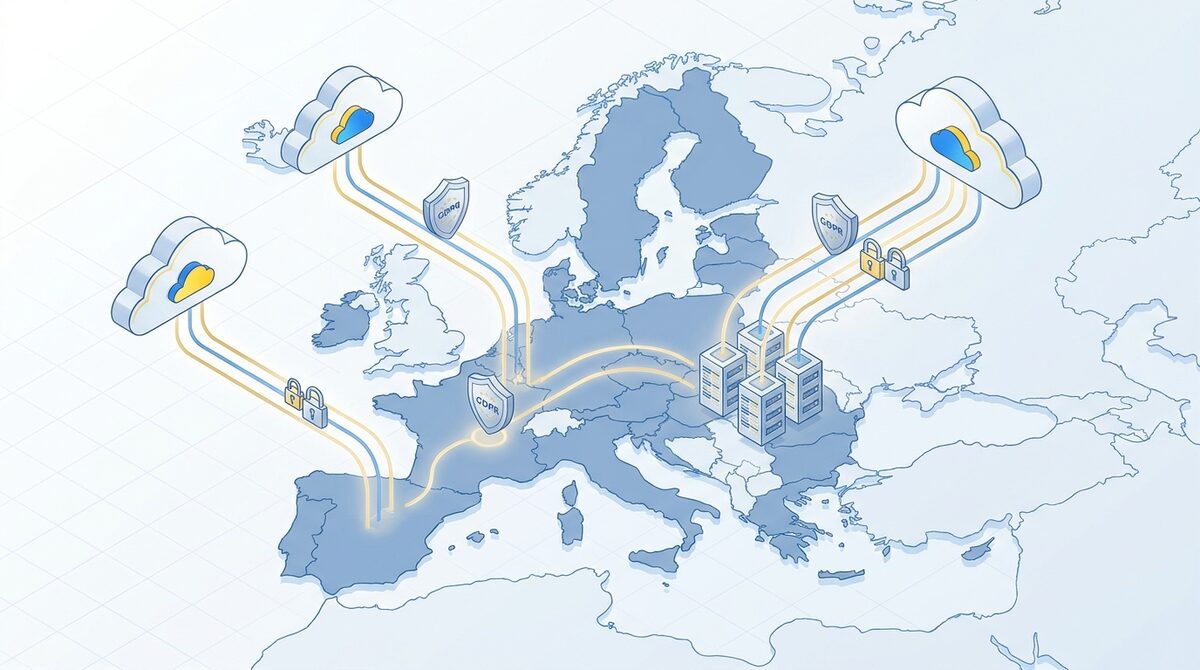
For European buyers, locality and control still matter. If AI data touches US providers, the same questions around residency and transfer risk from our EU data residency guide come back immediately.
4. Treat AI Act readiness as product strategy, not just compliance
The strongest European SaaS teams will use this moment to differentiate.
A good compliance posture can support better:
- enterprise conversion rates
- sales enablement
- partner approvals
- renewal confidence
- expansion into regulated verticals
This is similar to what happened with GDPR. Teams that prepared early looked expensive and cautious at first, then later looked credible and easy to buy.
A Practical 2026 Checklist for SaaS Founders
Here is the version that matters if you want to leave this page with a plan.
In the next 30 days
- Inventory every live AI feature and model dependency.
- Identify whether any feature affects employment, eligibility, access, fraud, or regulated decisions.
- Write a one-page AI usage policy for internal teams.
- Confirm what your model providers do with prompts, outputs, and training data.
- Add an AI review section to your product launch checklist.
In the next 90 days
- Build standard customer-facing AI documentation.
- Add logging, version control, and rollback for model changes.
- Create human-review flows for medium and high-impact outputs.
- Restrict or redesign any use case drifting toward high-risk territory.
- Update contracts, security docs, and procurement responses.
Before selling harder into enterprise or regulated sectors
- Create a formal AI system register.
- Map evidence for evaluation, testing, and monitoring.
- Align legal, product, and engineering on prohibited or restricted use cases.
- Prepare buyer-ready answers for fairness, transparency, data handling, and oversight.
Tools That Help With EU AI Act Readiness
No tool magically makes a product compliant, but the right stack makes compliance much less chaotic.
Tool categories to prioritize
| Need | What to look for | Why it matters |
|---|---|---|
| Documentation | policy wiki, AI system register, version history | lets you answer buyer and audit questions faster |
| Data control | EU hosting, access logs, encryption, regional processing | reduces privacy and residency friction |
| Observability | prompt logs, model/version tracking, incident alerts | helps monitor behavior after launch |
| Workflow control | approval steps, human override, escalation paths | crucial when AI output affects real decisions |
| Vendor management | DPA storage, subprocessor tracking, risk reviews | keeps model-provider risk from being invisible |
Practical stack options for European SaaS teams
1. European infrastructure first
If AI features are core to your product, hosting surrounding systems in Europe is the cleanest starting point. Review options in our best European cloud hosting providers guide and, for engineering-heavy teams, our best European DevOps and CI/CD tools roundup.
2. Model-layer flexibility
Many teams will still use a mix of US and European model providers. The key is to avoid hard-coding your business into one opaque provider setup. Keep provider abstraction where possible so you can switch based on privacy, cost, or customer requirements.
3. Workflow automation with approvals
If AI is being used inside ops workflows, automation should include review gates. Our European automation alternatives guide is relevant here because unreviewed automation can become a compliance problem quickly.
4. Audit-friendly analytics and logs
Do not evaluate AI output with a black-box analytics stack you cannot explain to customers. Use logging and analytics patterns that support retention controls, governance, and EU-friendly processing. Our GDPR-compliant analytics guide is a good base layer.
If you also need a concrete vendor shortlist while you build that governance layer, the AI & Machine Learning directory compares European AI vendors on pricing, hosting, and data residency, and best European AI companies 2026 covers what each one is actually for. That combination gives buyers both the operational controls and the actual EU-based tools to evaluate.
The directory covers more than model providers. Alongside established names like Mistral AI and DeepL, it lists Nalvin for product-team agents, Parloa for customer-service automation, Sana for enterprise knowledge workflows, and Graphcore for sovereign infrastructure — useful when your compliance review is about one of those rather than model access.
If the decision is spilling into adjacent infrastructure or analytics, the full European SaaS companies directory is the fastest way to widen the search.
Which SaaS Companies Should Worry Most Right Now?
Not every founder needs the same level of urgency.
Highest priority
- HR and recruiting SaaS
- fintech and fraud tooling
- health SaaS
- legal and compliance platforms
- any product scoring people or recommending actions with real-world impact
Medium priority
- customer support AI
- CRM and revenue workflow products using AI scoring
- analytics products using AI recommendations
- productivity tools with embedded automation and copilots
Lower immediate priority, but still worth documenting
- AI copywriting assistants
- note summarizers
- internal productivity features
- search and translation helpers
Even low-risk AI features still create procurement questions. They are just easier to answer.
Common Mistakes Founders Make
Mistake 1: Assuming the model vendor handles everything
Your vendor may help with technical controls, but your product packaging, workflow design, claims, and customer impact are still your responsibility.
Mistake 2: Treating AI compliance as only a legal task
Legal can interpret requirements, but product and engineering own the lived reality. If those teams are not involved, your documentation will drift away from the actual system.
Mistake 3: Waiting for exact enforcement details before acting
That is how teams lose six months. Buyers already care, and most of the useful work is governance, documentation, and design hygiene anyway.
Mistake 4: Overengineering low-risk features
Not every AI summary button needs an enterprise governance program. Match effort to risk.
Verdict: The Winners Will Make AI Easier to Trust, Not Just Easier to Use
The EU AI Act will not kill SaaS AI adoption in Europe. It will reward teams that can explain their systems, limit risky use cases, and prove they operate with control.
If your product uses AI in any serious way, the right move in 2026 is simple:
- inventory what you have
- classify risk honestly
- document providers and data flows
- add review and logging where outputs matter
- turn compliance clarity into a sales advantage
Most founders do not need a giant AI governance department. They need a disciplined operating system around AI before enterprise buyers force one on them.
For the broader compliance stack around this work, keep these guides close:
Further Reading
- AI & Machine Learning category
- Best European AI Companies 2026: Building AI Without Big Tech
- EU Data Residency Requirements: A Practical Guide for SaaS Founders
- Why Data Sovereignty Matters for European SaaS
- ePrivacy Directive Compliance 2026
- GDPR-Compliant Analytics Guide
- Best European Cloud Hosting Providers 2026
- Best European DevOps & CI/CD Tools for SaaS Teams 2026