European Transactional Email Services: Sovereignty Compared
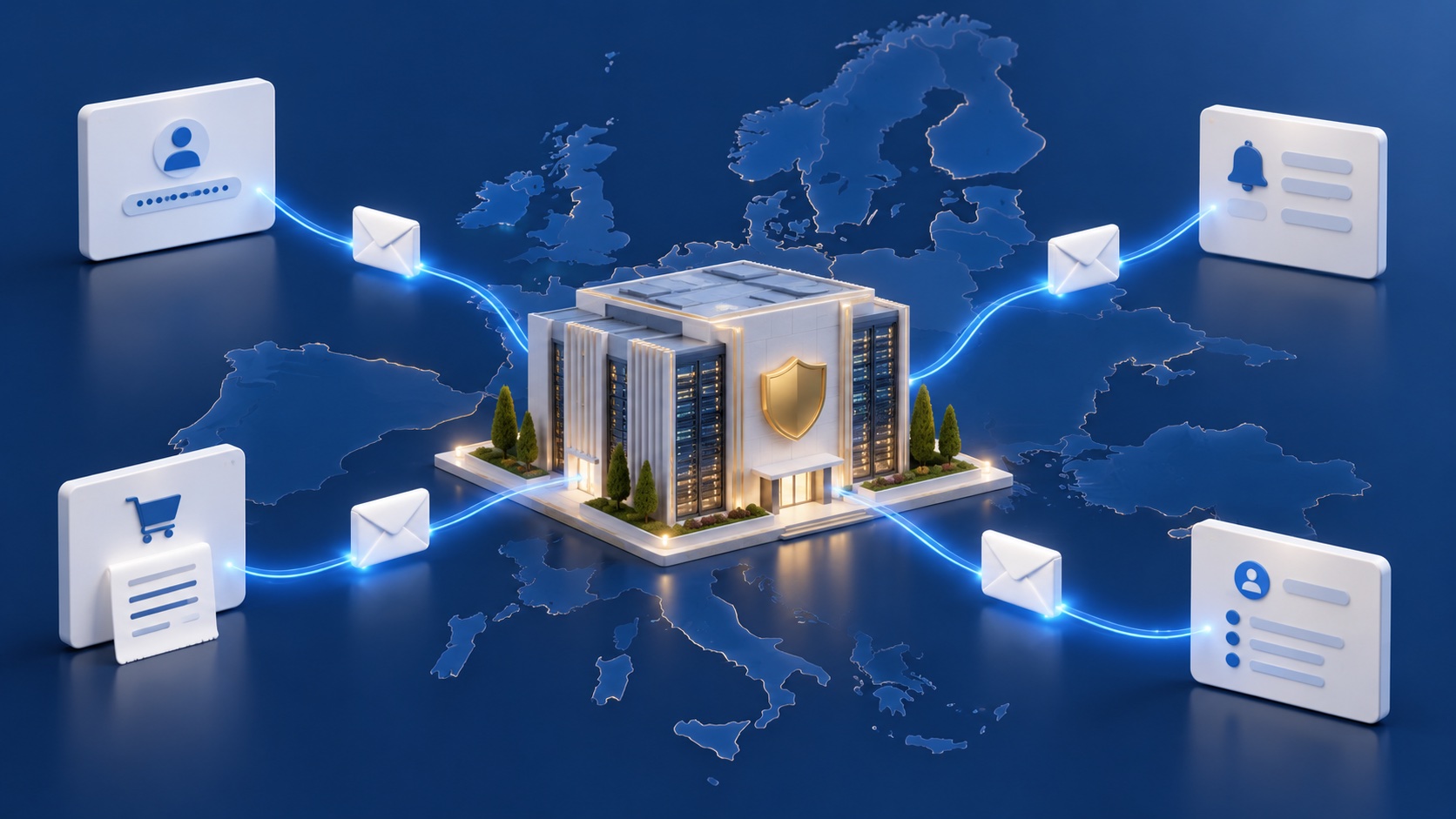
Your application can run on European servers while its password resets, invoices, and account notifications pass through a different provider’s infrastructure. Transactional email deserves the same scrutiny as your database: message bodies, recipient addresses, and delivery logs can reveal sensitive details about your customers.
There are European transactional email services that support API or SMTP sending, publish their processing terms, and offer alternatives to US-operated platforms. But a European address, an EU sending region, and control of the underlying infrastructure are three different things.
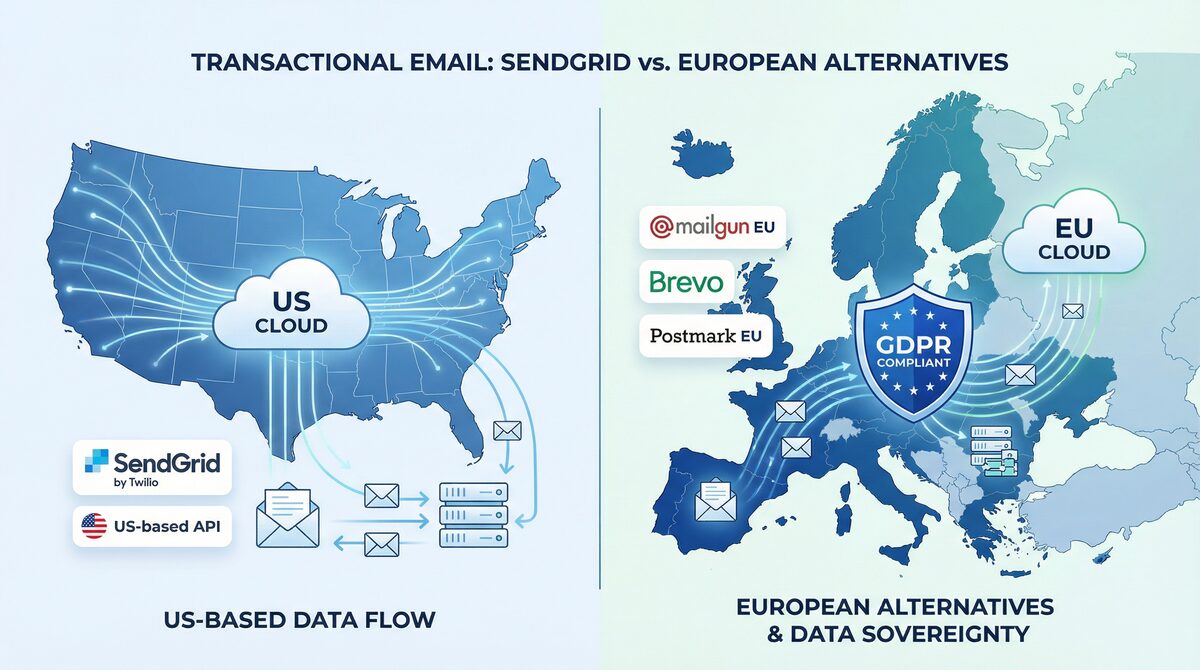
This guide compares Lettermint, AhaSend, Scaleway Transactional Email, and Postscale through that lens. The recommendations reflect their published documentation, checked on 4 October 2026, rather than an inbox-placement benchmark or a certification of their sovereignty. If your starting point is a specific incumbent, our European SendGrid alternatives guide covers the broader replacement decision.
Quick comparison: European transactional email providers
For a small application seeking documented EU email processing, start with Lettermint. For configurable retention and a provider-operated European delivery network, investigate AhaSend’s European configuration. For a cloud infrastructure service with usage-based pricing, consider Scaleway TEM. For sending combined with inbound processing and masked addresses, compare Postscale, paying attention to its mixed infrastructure dependencies.
| Provider | European base | Published hosting position | Entry pricing | Main qualification |
|---|---|---|---|---|
| Lettermint | Netherlands | Core email processing in the EU; named European service subprocessors | 300 emails/month free; Starter €10/month for 10,000 | Business-operation data and external recipient systems have a separate scope |
| AhaSend | Netherlands | Email storage on its own hardware in Germany and Finland; European delivery nodes | 1,000 emails/month free; paid Pro and Max plans | An optional US node requires explicit opt-in |
| Scaleway TEM | France | Integrated with Scaleway’s European cloud | Essential: 300 emails/month included, then €0.25 per 1,000 | Verify the TEM-specific contract and limits, rather than assuming every cloud assurance applies |
| Postscale | Estonia | Primary service data in the EU/EEA on European hosting providers | 1,000 shared send/receive emails/month free; Starter €9/month | Global network and operational subprocessors; sending and receiving share the quota |
Prices are the published entry offers, not a quote for every workload. Paid-plan details and source links appear below. Compare the same volume, retention period, and feature requirements before deciding which is cheapest.
What does sovereign transactional email mean?
Transactional emails are automated messages triggered by an application event: password resets, verification links, order confirmations, receipts, or account alerts. They differ from a campaign sent to a marketing list. Their timing matters, and a delayed message can prevent someone from signing in or completing a purchase.
For this comparison, sovereignty means assessing who controls the service and infrastructure, which jurisdictions are involved, and what control you retain over your data. We do not treat it as a binary badge.
Evaluate three separate layers:
- Company and ownership. Identify the contracting entity, its headquarters, and any parent company. A local subsidiary does not settle the ownership question.
- Processing and storage. Locate message content, recipient information, logs, backups, and support access. A sending IP’s location does not answer all of these.
- Infrastructure control. Identify the hosting, network, storage, and operational suppliers. Owning hardware is different from renting servers, although either can meet a particular procurement requirement.
Our data sovereignty guide explains why those distinctions matter when choosing software. For email, turn them into questions about specific data categories rather than asking a provider to tick a single “European” box.
An EU sending region is not EU data residency
Resend is a useful example. Its own GDPR documentation states that customer data, including message content and delivery logs, is stored in the United States. Selecting an EU sending region changes where mail is sent from, not where that data is stored. The same document describes its DPA and transfer safeguards; this is a residency distinction, not a claim that using Resend is automatically unlawful.
The recipient is outside the provider’s control
A European sender can deliver an email to a recipient whose mailbox is operated elsewhere. Lettermint explicitly distinguishes its EU email infrastructure from customer-directed delivery to external recipient systems. A claim about the sender’s storage should not be rewritten as a promise that every delivered email stays in Europe forever.
1. Lettermint 🇳🇱
Best for: Small applications and agencies seeking a straightforward email API with documented EU core processing.
Lettermint is based in Zwolle, Netherlands. It supports transactional email, broadcasts, inbound webhooks, and API or SMTP integration. That makes it worth evaluating when you want application messages and inbound handling without buying a separate service for each.
Its subprocessor register identifies UpCloud in the Netherlands for private cloud infrastructure, OVHcloud in Germany for backups, and Postmastery in the Netherlands for deliverability monitoring. It separately identifies services handling business-operation data. This is more informative than an unqualified “no third parties” claim: ask which category your own support requests and account information fall into.
Pricing: The pricing page lists 300 emails per month free. Starter costs €10/month for 10,000 emails, with additional emails at €1.50 per 1,000. Higher plans add capabilities; dedicated IPs are a separate add-on for Pro customers.
Strengths: Named service subprocessors, API and SMTP access, and an accessible paid entry tier.
Limits: Its European hosting depends on external infrastructure suppliers. Compare plan limits for domains, retention, and support before moving several applications into one account. EU processing of core email data does not mean every business-operation supplier is in the EU.
2. AhaSend 🇳🇱
Best for: Teams that want detailed infrastructure disclosures and control over message retention.
AhaSend is a Dutch transactional email service based in Amsterdam, with REST API and SMTP access. Its security documentation says email content, metadata, logs, and analytics are stored on hardware it owns in Germany and Finland. Delivery nodes in Norway and Bulgaria are described separately from storage locations.
The important qualification is the optional US node. AhaSend says it is strictly opt-in, and its DPA permits processing outside the EEA, including optional US infrastructure. If European processing is a requirement, document the selected configuration and the applicable contractual commitment. Norway is in the EEA, but outside the EU, which matters for policies requiring EU-only processing.
Pricing: The live pricing page offers 1,000 emails per month free, Pro with 25,000 included emails, and Max with 100,000. Use its EUR/USD calculator for the current paid amount and overage quote; we have not reproduced a paid figure from an older comparison article.
Strengths: Provider-operated European hardware, signed webhooks, sandbox testing, and retention controls that vary by plan.
Limits: Confirm both content and metadata retention for your selected plan. The US option means “European by default” should not become “European in every configuration.” Its security page still describes ISO 27001 as in progress; we have not counted that as a completed certification.
3. Scaleway Transactional Email 🇫🇷
Best for: Developers seeking transactional sending as part of a European cloud platform.
Scaleway is based in Paris. Its Transactional Email product integrates sending with its European cloud. The Essential offer includes five domains, one webhook per domain, reporting, and automatic blocklist handling. It is a practical candidate when email is one component of a larger cloud deployment.
Pricing: Essential includes 300 emails per month, followed by €0.25 per 1,000 emails. That usage rate is attractive for sending workloads, but check the complete bill and any additional features before comparing it with subscription products.
Strengths: Usage-based entry pricing and both API and SMTP integration.
Limits: Inspect the TEM capabilities and limits against your application’s attachments, traffic bursts, and message types. Request a service-specific account of content, logs, backups, and support access. The provider’s broader cloud positioning is not a substitute for the contract applicable to TEM.
4. Postscale 🇪🇪
Best for: Applications combining outbound email, inbound processing, and privacy aliases.
Postscale is operated by DNScale OÜ in Tallinn, Estonia. Its service terms describe transactional sending, inbound webhooks, masked email addresses, and delivery-event tracking. That combination can be useful for products where users reply to notifications or communicate through aliases.
Its subprocessor register places primary production service data in the EU/EEA, with Hetzner for core processing and OVHcloud for object storage. It also identifies Tailscale, Vultr, and Stripe for network, operational, or billing functions. Some processing is global, including the US. We therefore classify it as EU-hosted core email with mixed dependencies, rather than an entirely European infrastructure chain.
Pricing: The pricing page offers 1,000 shared sending and receiving emails per month free. Starter is €9/month for 10,000 shared emails, with extra usage at €1.20 per 1,000. Prices exclude VAT where applicable; annual billing is discounted.
Strengths: Sending, inbound processing, and masked addresses in one product, with detailed infrastructure disclosures.
Limits: Inbound traffic consumes the same quota as outgoing mail. If your policy excludes US-operated infrastructure or global operational metadata processing, review the disclosed suppliers before choosing it.
How to compare cost and deliverability fairly
Start with a month of actual application traffic. Separate outgoing messages from incoming replies, note daily peaks, and count the domains you need. Then request a price for that workload, including retention, overages, dedicated IPs, support, and any inbound processing.
For example, 8,000 outgoing messages and 3,000 inbound messages fit differently into an outbound-only allowance and a shared 10,000-message allowance. A cheaper headline subscription can still produce a larger bill for the second workload.
Sovereignty also says little about inbox placement. Test authentication, bounce events, complaint handling, and delivery latency to the mailbox providers your customers use. An API success response alone does not demonstrate that a password reset reached an inbox. We have not performed a comparative deliverability test of these four services.
For a pilot, send controlled test messages covering an HTML receipt, a plain-text notification, an attachment, and a time-sensitive verification link. Check the resulting event history and what your application does when delivery fails. Keep real authentication tokens and unnecessary personal information out of test logs.
A migration checklist for transactional email
Changing an email provider is more than swapping an API key. Complete these checks before your full cutover:
- Authenticate the sending domain. Verify SPF, DKIM, and DMARC alignment using the destination provider’s instructions.
- Preserve suppression information. Transfer relevant bounce, complaint, and unsubscribe records so the move does not restart unwanted sending.
- Rebuild event handling. Map webhook events, verify signatures, and handle retries without sending duplicate receipts or notifications.
- Test templates and attachments. Check rendering, plain-text alternatives, links, and file limits through the new API or SMTP service.
- Set retention and access. Record how long content and logs remain, who can read them, and whether support access changes the processing scope.
- Move gradually. Start with a bounded notification type, monitor failures, and have a rollback method that avoids sending each event twice.
Our SaaS switching guide explains how to assess export and exit procedures. For an email migration, pay particular attention to records your application needs after the old account closes, such as suppression lists and delivery history.
Frequently asked questions
Which European transactional email service is most sovereign?
There is no universal ranking without a definition of your requirements. AhaSend documents ownership of its European hardware, with a separately disclosed US option. Lettermint identifies European suppliers for its core email processing. Scaleway offers a European cloud-integrated service. Postscale has EU/EEA core hosting with mixed operational dependencies. Match those architectures to your policy rather than awarding every provider the same badge.
Is EU-hosted transactional email automatically GDPR compliant?
No. Location alone does not establish lawful processing. Review the purpose of sending, your processing agreement, retention, access, and applicable transfer arrangements. Our data residency guide explains why residency and compliance should be evaluated separately.
Can a sovereign email provider guarantee that messages never leave Europe?
It can make commitments about its own processing, but delivery also involves the recipient’s mailbox and any systems you connect. Ask for a clear boundary covering the provider’s content storage, backups, logs, and network dependencies. Keep recipient delivery and your own webhook endpoints separate in that assessment.
Do I need transactional email or email marketing software?
Use a transactional service for application-triggered messages such as receipts and verification links. If your main requirement is campaigns, audience segmentation, and nurture sequences, compare European email marketing platforms instead. Some providers offer both, but the pricing and operating requirements differ.
Which provider should you choose?
Shortlist Lettermint for an accessible API/SMTP service with documented EU core processing, AhaSend for configurable retention and its provider-operated European network, Scaleway TEM for cloud-integrated sending with usage-based pricing, and Postscale for combined sending, inbound processing, and aliases where its disclosed dependencies fit your policy.
Before committing, save the relevant DPA, subprocessor list, configuration, and pilot results. Those documents make a more useful buying record than a sovereignty slogan. The email software directory lets you compare adjacent providers once you have defined which data and infrastructure requirements are essential.